Academics
Campus and Community
Spelman College Joins Select Group of Research Colleges and Universities in Carnegie’s Redesigned Classification System
What Our Carnegie Classifications Reveal
 For decades, the most widely used classification framework in American higher education had no formal language for what Spelman College was doing. Not because the research wasn’t happening — it is. Not because the faculty were not highly engaged in research and creative pursuits — they are. Not because the students weren’t succeeding — they are and continue to do so. The Carnegie framework simply wasn’t built to see institutions like Spelman.
 In 2025, that changed.
The Carnegie Foundation for the Advancement of Teaching and the American Council on Education designated Spelman as one of a select group of Research Colleges and Universities in April 2025 — part of the most significant overhaul of the Carnegie Classifications in more than half a century. The designation does not belong to many institutions. It belongs to the College for specific reasons.A Classification System, Rebuilt
 For most of its existence since 1973, the Carnegie research designation framework recognized only one kind of research institution: the large doctoral-granting university. The R1 and R2 tiers, added in 1987, sorted institutions by a single measure — how many doctoral degrees they awarded and how much they spent on research. Institutions that did not produce significant numbers of Ph.D.’s or spend tens of millions on research and development had no formal designation, even when faculty and students were producing scholarship with real consequence.
 Under a partnership announced in 2022, the Carnegie Foundation and ACE replaced the single Basic Classification with a three-part system covering institutional identity, student access and earnings, and research activity. Within that new research tier, they introduced the RCU category for the first time — extending formal recognition to robust research enterprises at institutions that had never held a research designation, including those that award few or no doctoral degrees. To qualify, an institution must average at least $2.5 million in annual research expenditures.
Among more than 4,000 colleges and universities nationwide, only 216 met that threshold.
“Instead of limiting research designations to the select institutions that award Ph.D.’s, all types of colleges and universities will now be celebrated for their research contributions,” said Ted Mitchell, president of the American Council on Education, in a statement announcing the redesigned Carnegie Classifications.
Who Else Is on the List?
 The 216 RCU institutions span a wide range: master’s universities, baccalaureate colleges, special-focus schools, two tribal colleges, 37 private independent colleges, and a handful of community colleges.
Among women’s colleges, only six of roughly 30 in the United States earned the designation — Barnard, Bryn Mawr, Mount Holyoke, Smith, Wellesley, and Spelman. Among HBCUs, Spelman joins several institutions, including Alcorn State, Fisk, Meharry, Morehouse, Norfolk State, the University of the Virgin Islands, and Xavier University of Louisiana.
The Distinctions Narrow Further
Among all RCU institutions also classified as Opportunity Colleges and Universities with Higher Access and Higher Earnings, 33 qualify. Of those, only five also carry the Special Focus: Arts and Sciences classification — a designation that reflects the distinctive academic identity of institutions that hold it. Spelman is one of those five. The College holds both the HBCU and women’s college identities simultaneously. No other institution on the RCU list does.The Infrastructure Behind the Designation
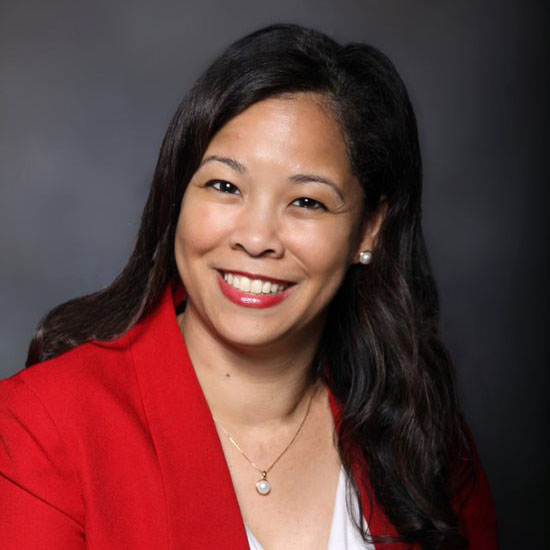 Recognizing that research and innovation are hallmarks of a Spelman education — integrated in both curricular and co-curricular fashion across all disciplines — Dr. Tasha R. Dejan (formerly Inniss), vice provost for research, established the Office of Research, Innovation and Collaboration in 2019 and expanded the research infrastructure to support scholarly and creative work across all four of the College’s academic divisions.
 “It was very important to me and other institutional leaders that the research enterprise included mechanisms to not only build on the foundation created primarily for STEM, but also to broaden the scope to acknowledge and support the research excellence college-wide,” Dejan said.
ORIC’s vision is to “empower the Spelman community to achieve and share scholarly excellence.”
The units dedicated to that vision include Research Development and Sponsored Programs, led by Margaret Farrow; Undergraduate Research and Training Programs, led by Brandi Taylor, C’2001; and Evaluation, Monitoring and Data, led by Lakesha Stevenson. In addition, Alisa Butler, works diligently with individuals and offices across campus to ensure smooth research operations. She was instrumental in creating the Administrative Professionals Institute (API). The RCU designation is a direct result of the support of the Research Development and Sponsored Programs unit — but the vibrant intellectual culture at the College is the result of the collective action of faculty, staff, and students.
“The research enterprise is not just one office or one strategy,” Dejan said. “It is the fabric of the institution that undergirds the scholarly and creative excellence of our scholars across campus. It is the people, the platforms, the policies, and the processes that contribute to Spelman’s designations and pride points.”
Spelman’s Equation for Success: Faculty Mentorship and Student Discovery
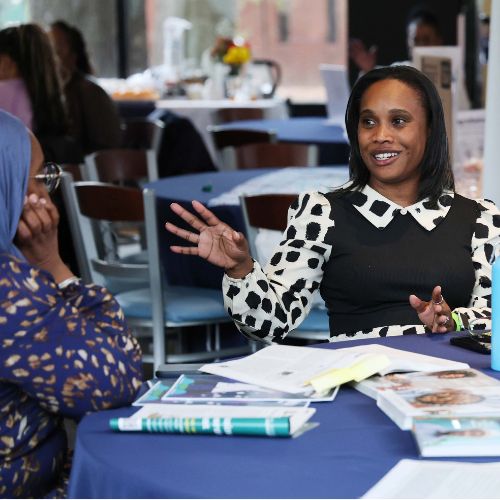 Consistent with the College’s mission of academic excellence and the “intellectual, creative, ethical and leadership development” of its students, faculty and staff are committed to developing scholars and leaders in every field. Research and innovation are embedded into the curriculum through course-based undergraduate research experiences. Faculty model the work — writing grants, directing programs and drawing students into active inquiry.
Staff contribute to that culture as well — a distinction worth noting at an institution that operates without graduate students and postdoctoral fellows that larger universities rely on. The College’s record as the country’s leading producer of Black women who earn Ph.D.s in STEM did not come from curriculum alone. It came from faculty who showed up for students — in the lab, in the field and at the writing table — treating that investment not as extra effort but as the work itself. That record has earned Spelman the designation of Center of Excellence for Black Women in STEM, directed by Natasha McClendon, Ph.D.
“Research at Spelman is not a peripheral activity,” Dejan said. “It is central to how we develop women who are prepared to lead and contribute across all disciplines — in the arts, humanities, natural and social sciences and mathematics.”
Faculty Mentors Across the Disciplines
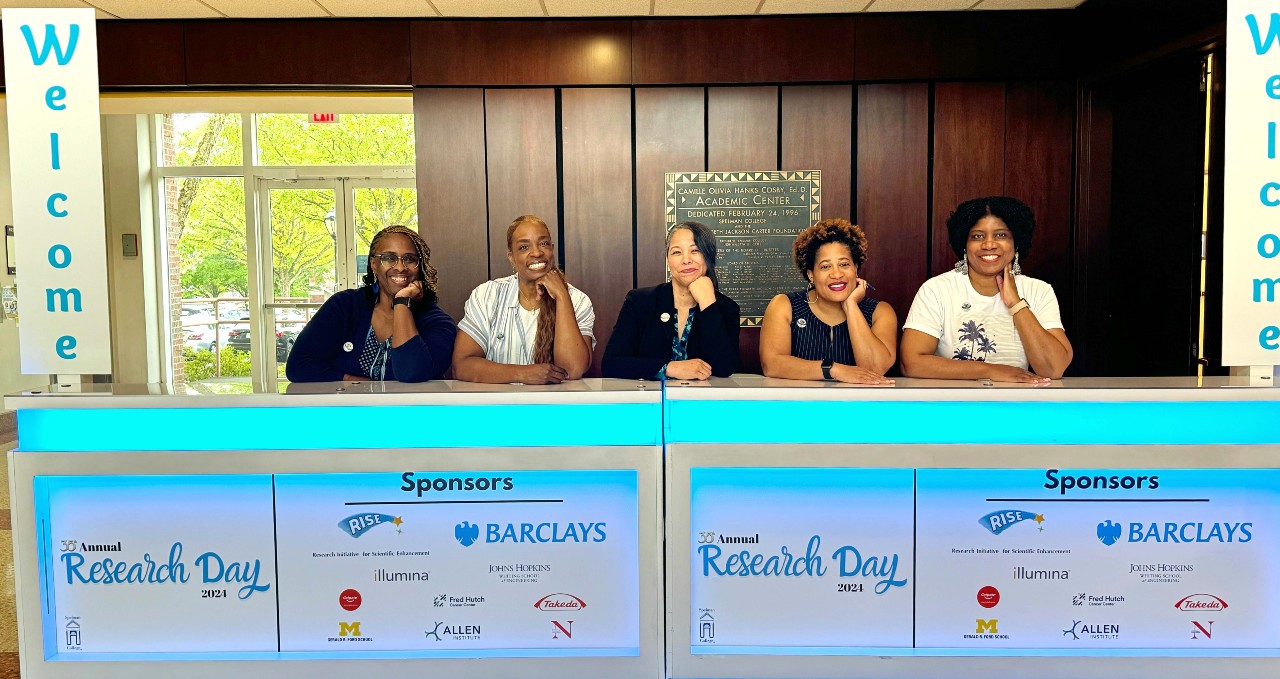
At the center of that enterprise are Spelman’s teacher-scholars — faculty who are active researchers and creative practitioners, mentoring students while advancing their own work. Ask what Spelman’s defining quality is, and the answer returns consistently: mentorship.
The following faculty and staff were recognized by their division chairs as exemplifying the teacher-scholar model through sustained mentorship, grant writing, program leadership and undergraduate engagement:
Arts Division (Chair: Marionette Holmes, Ph.D.)
Cheryl Finley, Jaycee Holmes, CiCi Kelley, Anjanette Levert, Kelly Mitchell, Abayomi Ola, shady radical, Kathleen Schaag, Eric Thompson, Jerry Volcy and Kathleen Wessel.
Humanities Division (Chair: Kathleen Phillips Lewis, Ph.D.)
Francisco (Paco) Chen Lopez, Fernando Esquivel-Suarez, Michelle Hite, Nami Kim, Rebecca Kumar, Nafeesa Muhammad, Gertrude Gonzales James de Allen, Patricia Ventura and Al Yasha Williams.
Division of Natural Sciences and Mathematics (Chair: Leyte Winfield, Ph.D.)
Daniel Ashley, Mentewab Ayalew, Davita Camp, Peter Chen, Armita Davarpanah, Nirajan Dhakal, Jessica Terrien Dunn, Michelle Gaines, Rosalind Gregory Bass, Christopher Oakley, Jeffrey Ehme, Shantesica Gilliam, Kimberly Jackson, NaTaki Osborne Jelks, James Melton, Michael McGinnis, Marta Dark McNeese, India Nichols-Obande, Anisah Nu’Man, Tiffany Oliver, Shanina Sanders Johnson, Monica Stephens, Mohammed Tesemma, Yonas Tekle, Bhikhari Tharu, Dongfang Wang and Kimberly Williams.
Division of Social Sciences and Education (Chair: Tinaz Pavri, Ph.D.)
Khalilah Ali, Nayena Blankson, Moon Charania, Dorian Brown Crosby, Danielle Dickens, Celeste Lee, Chatee Richardson, Rebecca Sen Choudhury, Rhonda Sharpe, Cynthia Spence, Nicole Taylor, Romie Tribble, Angelino Viscesza, Katherine Wiegand, Erica Williams, Miesha Williams and Unislawa Williams.
Where Research Comes to Life
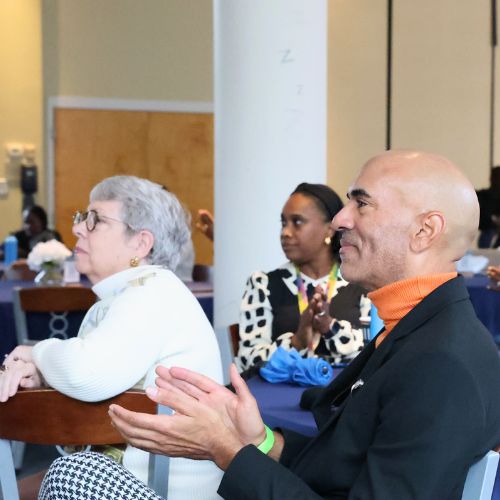
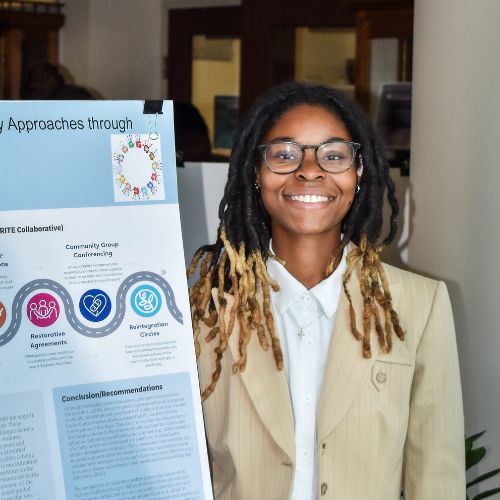
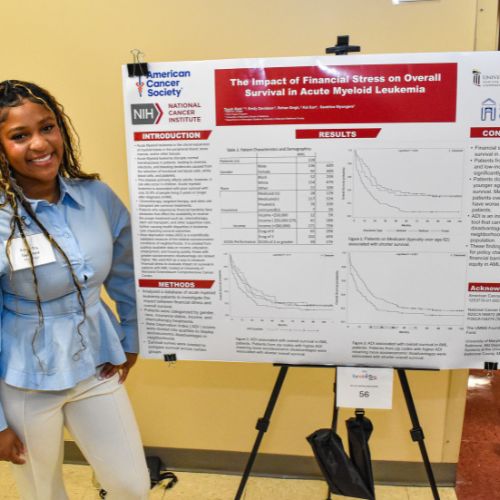
The RCU designation reflects a robust undergraduate research culture in which every field is taken seriously, and students are encouraged to follow their intellectual inquiries wherever they lead. Research Day — Spelman’s annual showcase produced by ORIC — brings that culture into full view. Picture a student presenting original research on the relationship between trauma and creative expression. Then another, two tables down, defending a study on algorithmic bias in health care diagnostics. Then another, presenting a comparative analysis of Toni Morrison’s narrative structure.
The event has been a fixture of Spelman’s academic calendar for more than three decades and now includes oral and poster presentations, performances and demonstrations from the Arthur M. Blank Innovation Lab. Each year, Taylor prepares students through professional development, elevates their work and leads a showcase that has grown far beyond its origins as Science Day.
“Ms. Taylor is a mentor and role model for our students since she was once in their shoes as a Spelman student,” Dejan said.
“When students see their own questions reflected in the research of this institution,” Dejan said, “something shifts. They stop asking whether they belong in research. They start asking what they want to discover and what they want to contribute to the world.”
ORIC Anchors the College's Research Culture Year-round
 In addition to Research Day, the Spelman Scholar Showcase, held in partnership with the Teaching Resource and Research Center headed by Lisa Hibbard, Ph.D., highlights faculty and staff research and creative work across every division of the College. The inaugural 2025 theme — “Rooted and Rising: Scholarship, Community and the Future of Learning” — speaks to Spelman’s research legacy and its forward momentum. Dessert and Dialogue, ORIC’s popular community conversation series, brings active intellectual projects into a communal setting, making the work visible and accessible. Together, these programs reflect an institution where the research enterprise belongs to the whole College, not a single department or season.
Measured by What Matters
The Carnegie Foundation updated its framework to ask more precise questions about more types of institutions. When it asked which colleges are doing the work — building research cultures, reaching underserved students, graduating them, and launching them — Spelman was on the list. The next time the Carnegie Classifications will be updated is 2028.
The RCU designation is a game changer. It arrives alongside other Carnegie recognitions -- the Institutional Classification of Special Focus: Arts and Sciences, the Student Access and Earnings designation of Opportunity College and University with Higher Access and Higher Earnings, and the elective classification of Community Engagement.
That breadth matters.
 Of roughly 3,000 institutions evaluated, fewer than 500 — about 16 percent — earned the Opportunity designation. Spelman is among an even smaller group: just 27 high-graduation-rate institutions nationally that earned it, meaning they reach underserved students, graduate them at high rates, and produce strong economic outcomes.
Researchers at Ithaka S+R called institutions in that group “field leaders in fostering student success.” Dejan noted that all the designations reflect the intellectual culture and the unwavering commitment of the College community to pursue research and creative excellence — whether in the classroom, in the lab, in the performance room, or in the community.
She and her team continue to build new collaborations to ensure that faculty, students, and staff have the knowledge and resources to sustain the robust research culture that is now formally recognized.
That is a designation.
It is also a mirror.
And Spelman is reflecting excellence —
now and well into the future.