
Students
Academics
Faculty
2026 COE-BWS Summit Brings HBCUs Together to Build STEM Ecosystems for Black Women
HBCUs Expand Collaboration to Shape the Future of Black Women in STEM
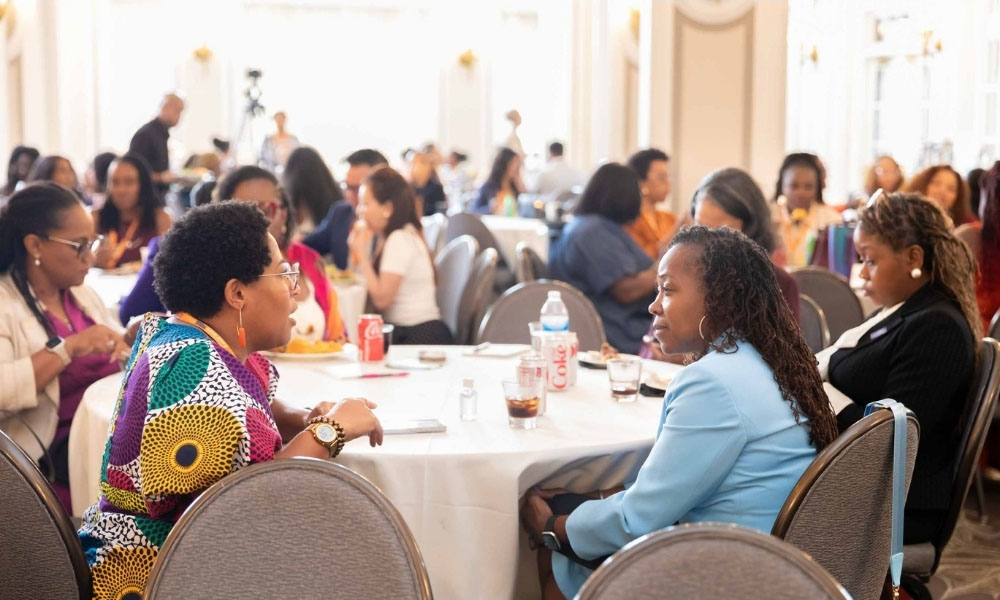 The Center of Excellence for Black Women in STEM at Spelman College brought together STEM leaders and researchers from HBCUs and other institutions for its third annual summit on Friday, Sept. 11, at The Georgian Terrace in Midtown Atlanta. Under the theme “Building from the Center. Designing HBCU-Led Ecosystems for Black Women in STEM,” the summit focused on strengthening the people, partnerships, research, resources and infrastructure supporting Black women across STEM.
This year’s summit expanded the Center’s focus to include partner institutions and opportunities for cross-institutional collaboration. Representatives from Tuskegee University, Morehouse College, Agnes Scott College, NORC from the University of Chicago, Emory University, Clark Atlanta University and Indiana University-Bloomington participated. The summit’s flagship panel, “HBCU Ecosystem Team Build,” brought together scholars for a cross-institutional conversation about collaboration, shared infrastructure and HBCU-led partnerships.
Tasha Dejan, Ph.D., the vice provost of research, credited Natasha K. McClendon, Ph.D., director of the Center of Excellence, with developing the vision behind this year’s gathering.
“The COE Steering Committee conceptualized the theme ‘Building from the Center.’ The whole idea of bringing HBCUs together to create this ecosystem and the people we invited. I want to give her and her team credit for the vision behind this day,” said Dejan.
McClendon said bringing additional institutions into the conversation reflects the Center’s goal of extending its reach and creating opportunities for institutions to learn from one another. “We also have a great steering committee that has supported our work in the Center of Excellence. We all worked together to establish this kind of thought process to invite other HBCUs so we can stretch our reach and have a knowledge exchange. In the future, we want to share with more people from different sectors and across all types of educational institutions."
Research was another central component of the summit. McClendon said the Center is working to become a resource for information and data focused on Black Women in STEM. “We want to be a place where people look for rigorous and dependable data information."
Participants explored the COE-BWS Data Hub, an interactive resource designed to support research, collaboration and institutional decision-making. Research lightning talks featured COE scholars, fellows, AUC partners and external HBCU researchers, followed by a research gallery walk and resource marketplace that connected participants with researchers, organizations and potential collaborators such as NORC, Coding with Culture, the U.S. Census Bureau, the Center for Black Entrepreneurship, and the HBCU Digital Library Trust.
Afternoon sessions extended the conversation into interdisciplinary innovation, with workshops exploring AI, historical storytelling, movement and dance, and science-educational video games and their potential applications in learning.
For Dejan, the gathering demonstrated the value of bringing people together around shared experiences, research and community.
“It’s about community building. When the speaker, LaTanya Robertson-Brown, Ph.D., talked about our ancestors, learning from them, community and co-creating for the betterment of us as a people, that’s the power in this room – the community and shared vision. I’m really excited about this day,” Dejan said.
Spelman President Ayanna Howard, Ph.D., said the summit’s theme represents a shift from conversations about how Black women can enter existing STEM systems toward imagining and building systems with Black women and HBCUs at their center.
“For far too long, conversations around diversity and science, technology, engineering and math have focused on margins; how to invite a representative in spaces that were never designed for them. 'Building from the Center' flips that paradigm entirely. We place HBCUs and Black women at the core of the design process. We ask what an ecosystem looks like when excellence, equity, innovation and belonging are foundational pillars from day one,” Howard said. “HBCUs have always held this answer. Our institutions produce the largest percentage of the nation’s Black scientists, doctors and engineers. We achieve it through intentional culture, high expectations and community support.”
The summit’s emphasis on research also resonated with Spelman students. Nyela Jackson Davis, C’2027, a sociology major from Baltimore and a public health minor, said research conducted by Black scholars can help address social issues.
“When Black people conduct research, you can address social issues better, especially in health. I’m a public health minor, so I think public health research is important, especially women’s health, because it doesn’t advance the same as men’s health,” Davis said. “There needs to be more black women in that research sphere so healthcare professionals know how to take care of Black women.”