Alumnae
Bridging the Digital Divide: Spelman Alum Earns Fulbright Award for Research in Kenya
Journei Ferguson's Summer in Kenya Inspired a Fulbright-Funded Year of Research and Community Impact
More than 8,000 miles from Spelman College’s campus in Nairobi, Kenya, Journei Ferguson, C’2026, spent her summer teaching middle and high schoolers their first lines of code.
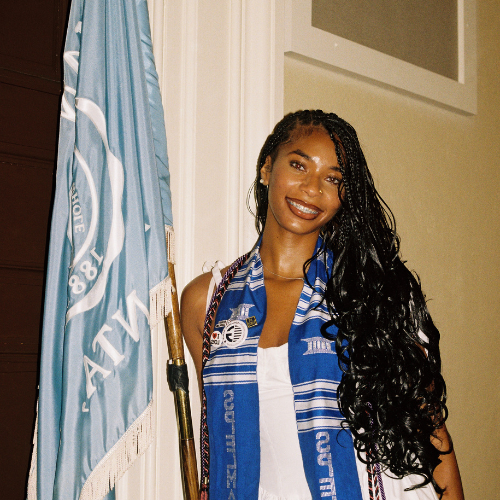 Ferguson was named a recipient of the prestigious Fulbright Program Research Award, which will fund a year of work and research in Kenya with the Angaza Center, a Kenya-based organization expanding digital literacy among students in low-resource communities. The Fulbright Program is one of the most competitive academic honors in the country.
“There is no limit to what I can do,” Ferguson said. “Life keeps sending me abroad.”
For Ferguson, the journey has always been the point. Her mother named her Journei after the path she walked through pregnancy, and Ferguson has spent her four years at Spelman discovering just how much that name would come to define her.
The Journey Abroad
Ferguson’s road to the Angaza Center began the previous year, after she was awarded the Obama–Chesky Voyager Scholarship for Public Service, a fellowship that pairs scholarship funding with a fully funded summer abroad built around a social issue. With it came a semester studying in London, which was her first time leaving the country.
 She wanted her next chapter abroad to connect her more directly to Black communities. A Google search pointed her toward the “Silicon Savannah” of Africa: Kenya. She found the Angaza Center, a nonprofit that works to expand tech literacy among students in Nairobi and beyond.
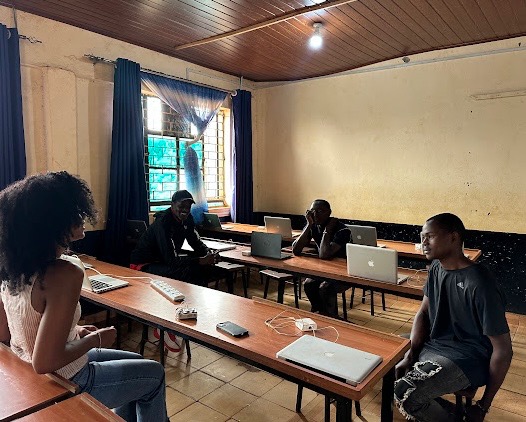
She arrived in Nairobi with thirty days and a long list of goals. Staying with the family of the Angaza Center’s CEO, Michael Odongo, Ferguson immersed herself in Kenyan culture. She attended a traditional ceremony, tried new foods, and even took a solo safari trip. At the Angaza Center’s Nairobi headquarters, she taught Python fundamentals to about 25 students encountering computers for the first-time and conducted research on the barriers to digital literacy in under-resourced schools, learning more about herself in the process.
By the end of the summer, Ferguson knew her work in Kenya was unfinished. With only about a month before the Fulbright application deadline in October, she completed her application with letters of recommendation from the Angaza Center’s CEO and the chair of the computer science department. Spelman alumna and writing mentor Ariana Benson, C’2019, reviewed her essays. Then came the wait. She found out she was a finalist in January and received news of the award in April.
“Even if I don’t feel qualified, I still apply,” Ferguson said. “Spelman has given me the confidence that I am qualified.”
Studying Computer Science
A Houston native raised by a single mother, Ferguson knew education could open doors for her. She earned her associate degree while still in high school. As a first-generation college student, Ferguson wanted to go to an HBCU and change the trajectory of her family. She learned about Spelman by watching YouTube vlogs from a Spelman student who had attended her high school.
Spelman is a safe haven,” Ferguson said. “It’s hard to leave Spelman without being successful. It’ll change your life and trajectory.”
Computer science wasn’t originally part of the plan. After seeing a TikTok video about CodeHouse featuring CodeHouse co-founder & Director of the Spelman Innovation Lab Jaycee Holmes-Nguyen, C’2016, Ferguson decided to study computer science.
Founded by Morehouse and Spelman alumni, siblings Ernest Holmes and Jaycee Holmes-Nguyen alongside their friend Tavis Thompson, CodeHouse works to level the playing field for HBCU students in technology through scholarships, mentorship, and hands-on training.
 Ferguson applied for the scholarship and along with the financial support gained a community of friends, mentors, and support that has helped her navigate college and her career, including internships at Microsoft, McKinsey, and the Department of Defense. Ferguson also co-founded The BIT (Black Innovators of Tech) with two other CodeHouse scholars Ashley Darling, C’2026, and Jakylan Fuller Reed to close the technology gap in underserved communities through coding education for middle and high school students.
“I can’t stress enough the crucial factors that played a role in my journey,” she says. “God, my mom, CodeHouse, the Spelman Computer Science Department, and Michael Odongo and The Angaza Center are all instrumental in my success.”
When her Fulbright fellowship in Kenya ends, Ferguson plans to bring what she’s learned back to the policy world, potentially pursuing a master’s degree in public policy to create structural change in tech policy.
Ferguson hopes her own path will inspire other women, especially young Black women.
“My deepest hope for the future, and the advice I live by, is that young Black girls continue to be daring, unapologetic, and completely sovereign,” she said.
Are You the Next Spelman Fulbright Scholar?
For students weighing whether to apply for a fellowship as competitive as the Fulbright, Ferguson’s advice is simple:
Be confident,” she said. “Kenya only had two spots, but I truly believed I was going to get it, so I applied. Don’t back out because you’re unsure of the odds.”
The Fulbright U.S. Student Program, sponsored by the U.S. Department of State, sends American citizens abroad annually for a year of graduate study, research, or English teaching as cultural ambassadors. Spelman students interested in applying are encouraged to connect early with the Office of Fellowships and Awards.
For more information, contact the Office of Fellowships and Awards in the Office of Undergraduate Studies or visit fulbrightscholars.org.