Students
Academics
Spelman Student Mariama Barry Revolutionizes Fashion Design with AI Pattern Generator
SIM-AI bridges the gap between creative vision and technical execution.
 When computer science major Mariama Barry, C’2028, couldn't communicate her clothing design vision to manufacturers, she didn't just accept the limitations. The Spelman College Innovation Lab Fellow created an artificial intelligence tool to solve the problem, earning second place at the College's Research Day in 2025.
Barry's AI Sewing Pattern Generator called SIM-AI addresses a persistent challenge in fashion: bridging the gap between creative vision and technical execution. The tool allows designers to describe their ideas in plain language and receive accurate, customized sewing patterns — no advanced technical knowledge required.
"The whole idea came to fruition because I realized I had the mind to visualize exactly what garments I wanted to create, but I lacked the technical skill at the time to draft patterns and know the exact construction of clothing," Barry said. "AI is the tool that closes that gap."
From Cybersticky to Innovation
Barry's journey began with Cybersticky, her fashion brand that operated from 2021 to 2024. She immediately discovered that fashion extends beyond aesthetics. "I quickly learned that fashion is more than just the visual sense; there is a strong, essential architectural component to it," she said.
As she pursued more complex designs, including modular clothing that can take different forms through pattern reconstruction, Barry encountered frequent manufacturing mistakes and communication breakdowns. One particularly memorable error occurred when she provided measurements without understanding basic terminology.
"A prime example was when I gave measurements without knowing what an inseam was, resulting in a child-sized sample," Barry said. "This clearly highlighted the need to know the exact construction instead of just the visual aspect, as I realized that if I could speak their language, the technical language of construction, it would greatly improve product quality and timelines."
Addressing Industry Gaps
Barry, who talks in the video on this page about her work, identified significant inefficiencies in traditional pattern creation. Patterns available on platforms like Etsy weren't complex enough for her needs, while professional CAD software like CLO3D presented a high barrier to entry.
"Even professional CAD software like CLO3D had a high barrier to entry, being very difficult to use without prior in-person pattern drafting knowledge," she said. "This led me to create the AI Sewing Pattern Generator, a tool that allows for complex designs while simultaneously teaching the creative exactly what is possible in fashion construction, thus closing the gap between visualization and technical execution."
Barry noted an additional challenge for creative entrepreneurs: "Often, as a creative, I wanted to focus on design but also had to manage the business."
How the Technology Works
The generator operates by having users describe their desired design with key details like fabric choice and sizing. The system then compares the prompt against thousands of patterns stored in its database, pulling the most applicable pattern based on textual comparison before modifying it according to specific requirements.
A crucial feature is what Barry calls the "rational component," which addresses creative expectations versus technical feasibility.
"This addresses the line between creative expectation and technical feasibility, so if a user requests jeans but specifies spandex fabric, the system can rationalize the design constraints without limiting creativity," she said.
Mentorship Powers Progress
Barry credits three Innovation Lab leaders as central to her success: Dr. Jerry Volcy, Professor Jaycee Holmes, and Eric Thompson.
"Professor Jaycee Holmes has been instrumental in business development, recommending approaches that guided my research day preparation and helped me identify which factors to eliminate to reach a viable MVP at this stage," Barry said. "Eric Thompson has served as a great technological mentor from the beginning, helping me understand the science behind computer science, read data effectively and utilize it to its best ability for my program."
She describes Dr. Volcy as "a powerhouse in computing and artificial intelligence," noting he has been "extremely helpful in reviewing the constraints of certain tools and showing me how to leverage existing AI capabilities and expand them through my own creative horizon."
Empowering Designers, Promoting Sustainability
Barry envisions the tool serving independent designers, aspiring creatives intimidated by technical barriers and clothing brand owners who understand fashion but lack manufacturing expertise.
"These owners often experience significant delays and manufacturing hardships due to their limited knowledge of fashion construction," she said.
She also sees sustainability applications: "I believe this tool can be central to expanding the lifespan of existing clothing and becoming a sustainable method for fashion deconstruction and upcycling. If users can also upload their existing designs, know exactly how their clothing is made and understand where they can make modifications, it promotes longevity."
Barry's vision is comprehensive:
"Ultimately, I believe this tool will educate, innovate and serve as an unmatched catalyst for modern, sustainable fashion design."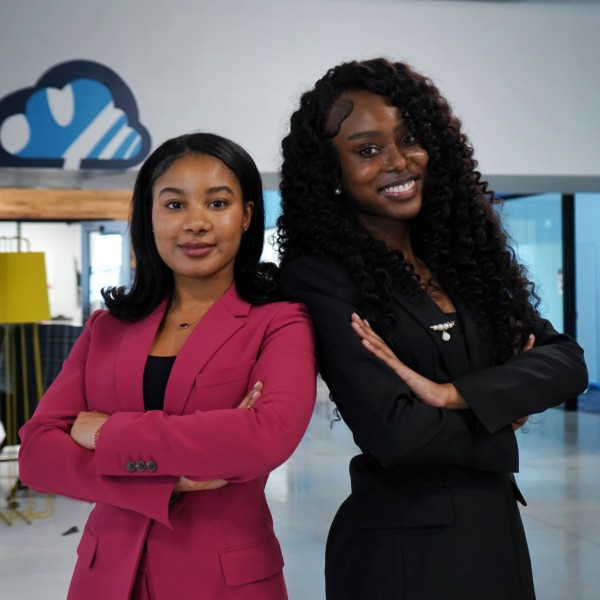
The Fellowship Experience
Being an Innovation Lab fellow has shaped Barry's approach to large-scale project management. "Being an Innovation Lab Fellow has taught me how to manage a project of a grand scale while successfully balancing my responsibilities as a student," she said. "This experience has been invaluable; it has truly clarified what I love to do and helped focus my career goals."
She finds inspiration in the collaborative environment: "It is so heartening to see the passion and progress the other fellows are making on their own projects every two weeks. The lab fosters a band of highly talented individuals, and simply being around that energy is incredibly inspirational."
Barry is emphatic about the program's impact: "The Innovation Lab has genuinely pulled the best out of me, and I hope to continue to innovate while being supported by the ever-expanding space of Spelman College and the Innovation Lab. I do not think I could have made it this far without the support of the College and the lab."
Building a Global Fashion Tool
Barry now works with House of Sticky on design work and plans to use the venture "in collaboration with my tool to show other brand owners the potential success of using it."
With Spelman computer science major Nyah Rene, C'2026, Barry recently completed the minimum viable product and plans customer analysis in the coming months. Their strategy focuses on local designers first before expanding nationally and globally.
"There is significant excitement surrounding the tool, as many people are eager to use it to streamline or upgrade their current labels," Barry said. "This includes both established designers and those who want to start designing and are waiting for a tool that can help them do exactly that."
Early feedback from fashion industry professionals has been positive, with users providing "crucial areas for improvement, which we are now actively including in our technology."
Looking ahead, Barry sees enormous potential:
"As for the future of this technology, I see it becoming a global tool for the fashion industry."
The project represents the convergence of Barry's passions:
"This tool perfectly merges technical creativity and entrepreneurship because it can single-handedly become a hot spot for the entire production process, from ideation to the actual physical product, especially when integrated with the industry contacts it can provide, " said Berry.
Barry's ambitions extend beyond the tool itself: "Working on this tool has empowered me to continue with my entrepreneurial journey, as well as to see a significant space for myself within the currently emerging fashion and technology industry, and I hope to become a leader within it."
"I challenged myself with a 19-credit course load (spanning mathematics, language, and CS) and I’m proud to share that I maintained a 3.8+ GPA while managing several deep-rooted passions," said Barry. In the tech landscape alone, Barry's last semester highlights included finalizing the 2nd back-end iteration of "Sim-AI," as an Innovation Lab fellow; joining Emory University's Hatchery Incubator Program, and competing with the Spelman Programming Team.
About the Innovation Lab Fellowship
The Innovation Lab is Spelman's creative commons for interdisciplinary ideation, design and making. The fellowship program guides students through year-long projects in maker, gaming or entrepreneurship tracks, providing mentorship on practical technologies and methods for materializing and productizing student innovations. Approximately six fellowships are offered annually.