
Students
Academics
Spelman College Senior Mackenzie Hickson Was Named Rhodes Scholarship Finalist
A Story of Compassion, Loss and the Power of Love
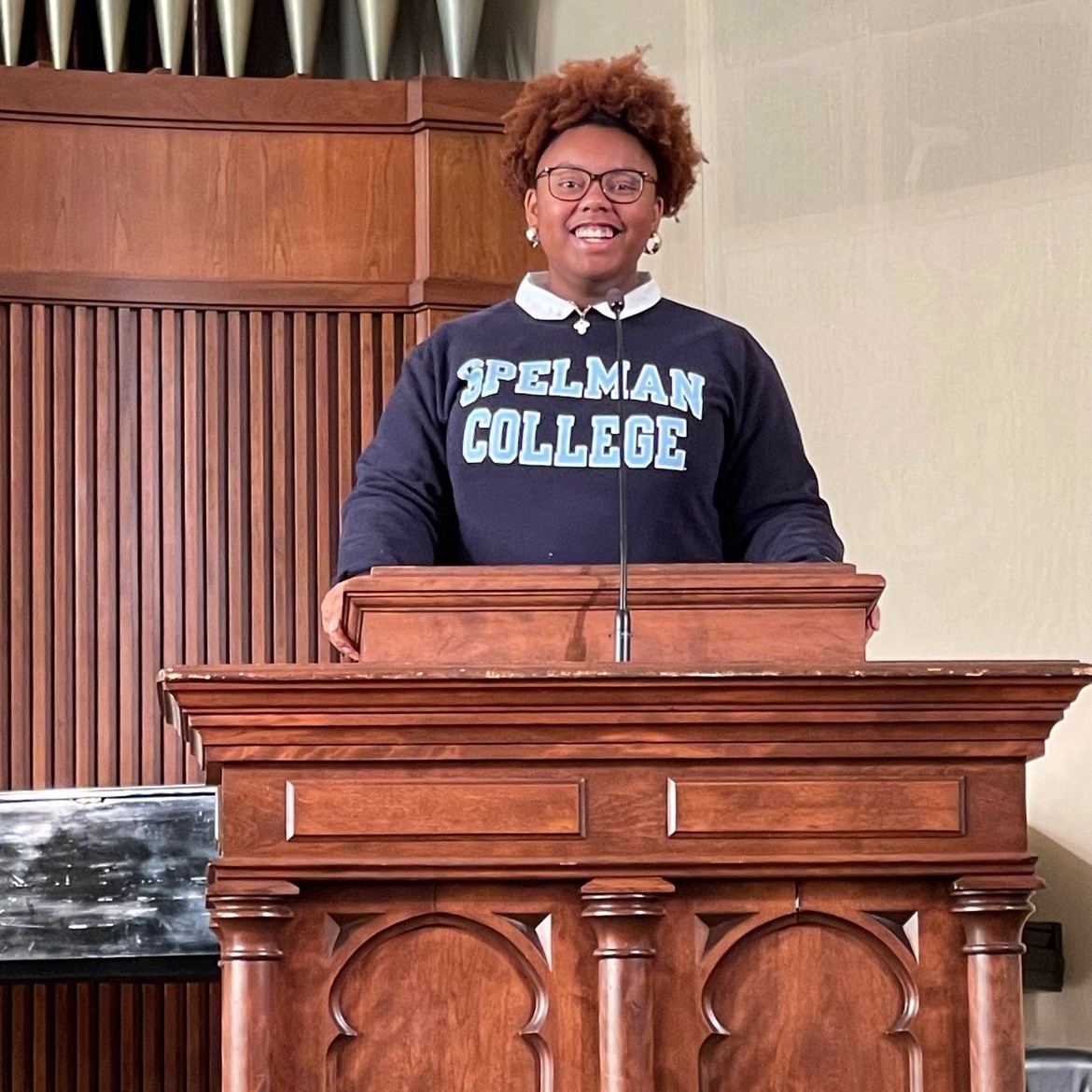 Mackenzie Hickson, a class of 2026 honors student with a comparative women's studies minor and health sciences major at Spelman College, was named a finalist for the prestigious 2026 Rhodes Scholarship. Selected from a pool of 965 candidates who received formal endorsements from 264 colleges and universities nationwide, she represented a district that includes Georgia, South Carolina, and North Carolina.
The Rhodes Scholarship, established in 1902, is widely considered the most prestigious international fellowship award in the world, providing full financial support for graduate study at the University of Oxford in England. According to Ramona L. Doyle, American secretary of the Rhodes Trust, "while academic excellence is essential as a basis for selecting Rhodes scholars, it is only the beginning. A Rhodes scholar should demonstrate ambition for social impact, strong leadership, empathy for others, and an acute awareness of inequities."
The trust seeks scholars of exceptional character who are committed to making a profound difference in the world. Hickson's selection as a finalist — advancing further in the competition than all but 238 of the 965 endorsed candidates — represents a groundbreaking achievement for Spelman. Her accomplishment continues a legacy of HBCU excellence in the Rhodes competition, joining recent scholars from fellow institutions Howard University and Morehouse College.
A Path Forged by Loss
Hickson's journey to becoming a Rhodes finalist has been profoundly shaped by personal tragedy that would have broken many, but instead crystallized her life's purpose. In 2017, when Hickson was in seventh grade, her father — a Morehouse College class of 1995 graduate —suffered a sudden cardiac arrest the morning after attending his children's school award ceremonies.
"He had taken off work that day, which he never did," Hickson recalled. "He was always a workaholic, working overtime, trying to get a second job — he was a provider. He came to our award ceremonies and was just beaming from ear to ear. He was always so happy at those kinds of things. And then he had a sudden cardiac arrest the next day."
What followed was a three-year battle that exposed Hickson and her family to the brutal realities of a healthcare system that seemed designed to strip away dignity rather than restore it. From the very first day in the ICU, a doctor coldly told the family "the prognosis is bleak" and suggested they "pull the plug." Her mother, Melissa Hickson, fought tirelessly — and often alone — against doctors, insurance companies, and medical facilities that seemed determined to deny her husband basic care.
This experience formed the basis of Hickson's Rhodes personal statement: "Discovering that my father, shortly after dropping me off at school one ordinary morning, had suffered a sudden cardiac arrest was the most crushing news I never expected. Clinging for life in the local hospital ICU for months, he became, as Thomas Hardy describes, a dead man walking." Her father passed away in June 2020. But the lessons from those years became foundational to Hickson's understanding of structural violence, medical racism, and the value society places —or refuses to place — on Black disabled lives.
Creating a Culture of Compassion
Hickson's experiences have also revealed to her an urgent truth: the healthcare system and society at large desperately need a culture of compassion — one that sees patients and marginalized people as full human beings rather than demographic categories or case files.
"I wish the medical field spent more time making doctors understand that these are not just 'disadvantaged populations,'" Hickson said. "That's my brother you're talking about. We have to love these people like no other because we have to fight for every single person."
This philosophy extends beyond medicine to every system that touches vulnerable lives. Hickson's short documentary, "The Urban Epidemic," employs Jamaican-American sociologist Orlando Patterson's conceptualization of "social death" to critically analyze how poverty and race strip people of their humanity in cities like Atlanta and Baltimore. Through interviews with community members and elders, she reveals how "poorness, like Blackness, strips the humanity of those afflicted by their social condition leading to a complete loss of resources, healthcare, love and life."
Her experiences volunteering at the Fulton County jail deepened her understanding of how systems of oppression mirror each other. "The first guy I met when I went to the Fulton County jail, was named Michael. My dad's name is Michael," she said. "He's about the same age as my dad. He's educated. I have no idea why he's in jail, but what I know is that he is a human being, a whole human being."
As a Newman Civic Fellow, Hickson is developing a program where college students engage with justice-impacted individuals through a discussion-based gender studies course. She also advanced the bell hooks Junior Honors Program, an innovative initiative where high school girls and femmes develop critical thinking skills through reading and writing — not to improve test scores, but to cultivate reflection, intellectual sovereignty, and love for their own humanity.
Discovering Rhodes
Hickson's path to the Rhodes Scholarship was unexpected. "I didn't even think I was applying to Rhodes," she said. "I was overhearing one of my classmates talking about applying to Rhodes and Marshall, and I thought you had to want to be a diplomat."
Her perspective shifted after attending a Phi Beta Kappa Key Into Public Service conference where she met a Rhodes Scholar from Princeton who spoke about Oxford not just as a credential, but as an educational experience that opens every door for scholars to explore their fullest potential.
In her personal statement, Hickson articulated her vision: "Through my pursuit of the Rhodes scholarship, I endeavor to answer these questions in my studies of public health, life at the margins, and visual narrative, employing the intimate artistic experience to shed light on raw stories and lift the fragile veil separating simply being alive and truly living."
From Pain to Purpose: A Scholar-Activist Emerges
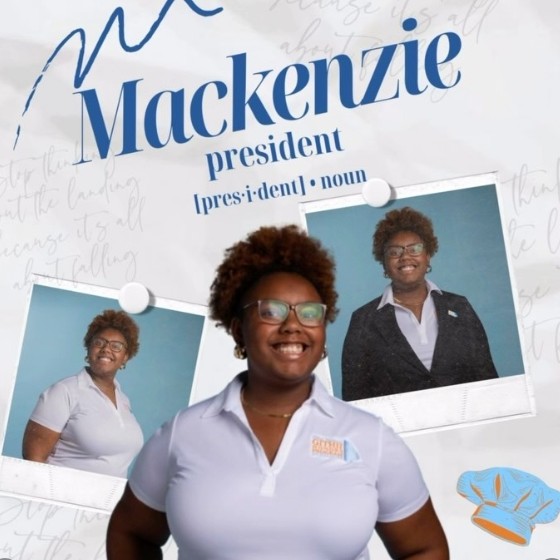 "Mackenzie embodies the ideals we foster at Spelman — intellectual rigor, moral clarity, and a genuine commitment to transforming civic life for the sake of human dignity and flourishing," said Michelle Hite, Ph.D., associate professor of literature, media and writing and director of the Honors Program.
"It has been a privilege to witness her growth, her seriousness of purpose, and her vision for social change. She carried herself with extraordinary grace throughout this process, and I am deeply proud of her."
As president of the Ethel Waddell Githii Honors Program Student Association, Hickson has demonstrated exceptional leadership both on campus and in the broader Atlanta community. She played an instrumental role in launching Spelman's first-ever Deliberative Exchange Team and proudly describes herself as a scholar-activist — someone who believes intellectual work must be inseparable from service to humanity.
Her commitment to social justice extends far beyond the classroom. Hickson regularly volunteers with El Refugio, supporting immigrant families impacted by detention, and works to combat food insecurity through partnerships with the Atlanta Community Food Bank and Urban Recipe. Her work is deeply rooted in her upbringing in a working-class family where community service was not a choice but a way of life.
Prepared for Excellence
Hickson's journey to becoming a Rhodes finalist was supported by dedicated mentorship from Spelman faculty. Dr. Hite, along with Ariana Benson, MFA, assistant program director of the Honors Program and the class of 2019 valedictorian, provided crucial guidance throughout the rigorous application process.
Benson's own lived experience as a Marshall Scholar while at Spelman — an opportunity that enabled her to study at Royal Holloway, University of London — gives her unique insight into the rigor and excellence with which Spelman prepares students for prestigious scholarships.
"It has been an incredible honor to work with a student as curious, diligent, and generous as Mackenzie," Benson said. "That her brilliance ranks equally among the above qualities is, in itself, impressive; that she employs it in service of them — in true service to others and the world—is what makes her truly remarkable as a storyteller and a human being."
A Community-Centered Approach
Spelman's interim president Rosalind Brewer praised Hickson's approach to social change. "Mackenzie Hickson's work demonstrates strong potential for creating innovative and collaborative solutions to public challenges," Brewer said. She also highlighted that Hickson's work "emphasizes relationship-building, empathy and critical inquiry, allowing her to develop sustainable and community-centered strategies for social change."
"Whether leading campus initiatives or partnering with local organizations, Mackenzie excels in diverse environments and inspires others to think critically, act compassionately and advocate effectively for justice," Brewer said.
The 2026 Rhodes Scholar Class
The final round of the selection process is notoriously rigorous. Past finalists have reported being asked questions ranging from "What is your vision for the world in 100 years?" to challenging philosophical queries and scenario-based questions designed to test not just knowledge, but the ability to think critically under pressure. Hickson participated in finalist interviews on Nov. 14-16 in Atlanta. Sixteen independent selection committees met simultaneously across the country to interview 238 finalists. The committees selected 32 Rhodes Scholars from among these finalists.
Including this year's cohort, 3,706 Americans have received Rhodes Scholarships since the first U.S. class in 1904, representing 329 colleges and universities. The 32 American scholars selected this year will join an international cohort of just over 100 scholars from 25 other Rhodes jurisdictions worldwide, along with two Global Rhodes Scholars, to begin their studies at Oxford in October 2026.
Reflecting on her desire to win the coveted award, Hickson said: "This is not just like, 'Oh yeah, it would be cool to call myself a Rhodes Scholar.' What I wanted from my experience at Oxford and in my graduate education in general is to have a robust and rich educational experience."
Though Hickson was not selected as one of the 32 Rhodes Scholars, her achievement as a Rhodes finalist stands as a testament to her exceptional scholarship, character, and commitment to service.
"Mackenzie is a shining example of Spelman excellence," said Dr. Mark Lee, provost and senior vice president. "She stands firmly in that tradition: rooted in community, attuned to history, and prepared to engage the world with courage and imagination. I can't wait to see the world as influenced by Ms. Hickson."
Hickson's Message to the World
When asked what she wants people to understand from her Rhodes candidacy, Hickson's answer was both simple and revolutionary:
"I charge them to consider compassion in everything that you do, and to understand that you have a responsibility to the people that you're trying to save," she said. "And Spelman is supposed to be a school, a place where you're making a choice to change the world, and if you want to change that world, you need to look it in its eyes and see it for its fullness, and to understand that every single person that you meet is living their own reality and that they have value."
For Hickson, this isn't abstract philosophy — it's a lived ethic that shapes every choice she makes.
"What I want my legacy to be remembered as someone who cared, someone who loved, someone who acknowledged that these people that I see in my community are human and that I respect them," she said. "That I want them to live good lives, that I want them to have everything they need to be successful, to be happy, to feel loved by me, by everyone, and to have a life that's worth living."
Dreaming Big by Acting Small
In an age that often celebrates grand gestures and viral moments, Hickson offers a different vision of impact — one rooted in the radical belief that transformative change happens through sustained, local, compassionate action.
"It feels radical to imagine a world that's grounded in love, and especially in loving blackness," she said. "But we can make that for ourselves. And what I hope people understand is that that doesn't have to be huge, systemic, flashy changes. It doesn't have to be like, I'm the next President of the United States."
Instead, Hickson embraces what she calls "dreaming big while acting small."
"I'm a dreamer. I dream big, but my dreaming big means that I can act small," she explained. "My work doesn't have to change the whole landscape of this entire system for everybody in this whole country. What this can mean is that this one village, this one community of 300 people, have access to clean water. I've seen it happen with my own eyes and it's beautiful — to see that people have resources to live, to see that they have a nurse, that they have a hospital or a small clinic, to see they have a school, to see they have a church, to see they have infrastructure to lead dignified lives. And that is meaningful."
In Mackenzie Hickson, Spelman has not just a Rhodes finalist, but a young woman whose vision of compassionate action offers a blueprint for how we might all engage with a broken world — not with grand pronouncements, but with the steady, determined work of seeing each person's full humanity and fighting for their right to live a life of dignity, love and meaning.
That legacy, perhaps, is worth more than any scholarship.